
What are Claude Skills?
Hint: Specialised Instructions!

I nearly fell off my chair when I saw that Claude released ‘Skills’.. What is a Skill for an AI like Claude? The technical documents can be a bit dense, so I will break this down for you and use Acapulco, in Mexico, my current home to provide a metaphor.
Imagine Claude is an incredibly gifted diver. Truly one of the best. You can put it in the water anywhere in the bay, and it can explore, understand the currents, see the fish, it just gets it. It’s brilliant.
But the ocean has specific jobs, specific secrets. A Claude Skill is the specialised gear you give that expert diver for a particular mission. It’s the knowledge that turns a generalist into a master of a specific task.
The Gear for the Mission
Think about it. Your diver, Claude, is already in the water. But you have a unique goal.
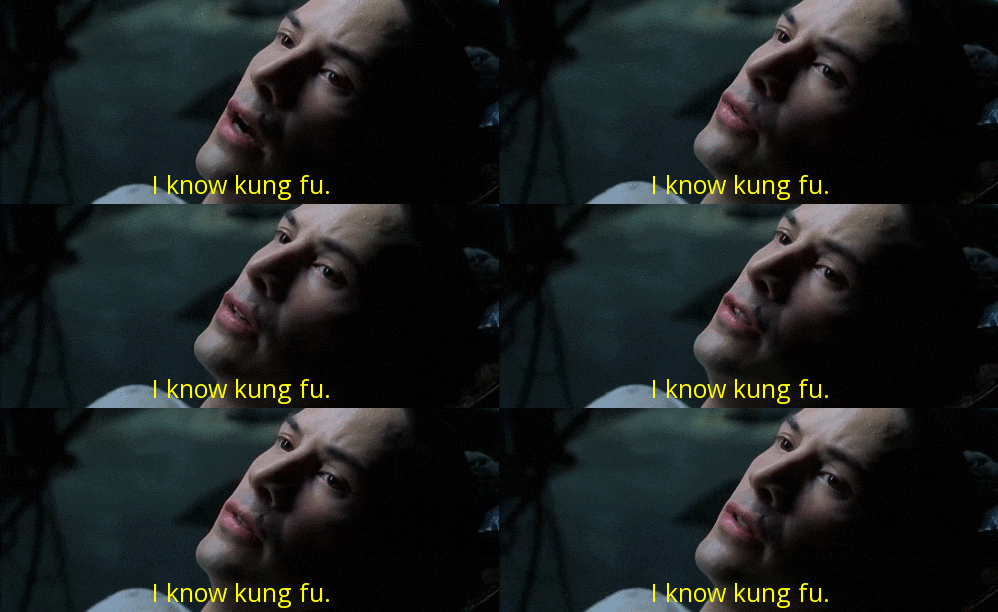
Maybe you want to perfectly photograph the diamond-shaped stingrays that glide over the sandy floor near Roqueta Island. They move in a particular way, shimmering when the light hits them just so. A “Stingray Photography Skill” is like handing the diver a custom underwater camera with the right lens, the right filter, and a small card that says, “For the best shot, wait for the morning light and approach from this angle.” The diver already knows how to swim and see, but now it has the precise tool and technique for one specific, beautiful outcome. It provides that extra layer of detail for a task you need done consistently. Anyone else think of the Matrix here?
Then there is the challenge of finding the iguanas that I am weirdly obsessed doing. They’re everywhere, but they have their favourite spots, hidden ledges where they sunbathe away from the tourists. An “Iguana Spotting Skill” is like giving your diver a secret map, hand-drawn by a local. A little checklist. “First, go to this specific cluster of rocks. Wait until the sun is high. Document their behaviour in this exact format.” This gives Claude a workflow, a series of steps to follow for complex tasks so nothing gets missed. It ensures a mission is completed flawlessly, every single time. It provides that essential structure.
My favourite metaphor, though, is the fishing lure. Anyone can try to fish, but a local fisherman might have a lure that’s been hand-carved, passed down through generations. It’s not flashy. But it works in these specific waters because it embodies a deep, localised knowledge what the fish here bite, how they move, the way the current pulls. A Skill can be like that lure. It holds your unique, specialised knowledge. The secret sauce. The processes and data that only you or your team understands. You give this to Claude, and it can now operate with that deep, insider wisdom.
Crafting Your Own Tools
So, when you decide to make one, how do you do it? you have to think like an artisan, a craftsman.
Your first job is to be focused. An iguana, when it’s about to strike a piece of hibiscus, is completely still, all its energy directed. Be like that. Don’t tell Claude the history of diving before you hand it the camera. It already knows. Just give it the new information, the key instructions it’s missing. Assume intelligence and provide only the essential, missing piece.
You also have to decide how much freedom to give. This is critical. For some tasks, the water is deep and the path is narrow, bordered by sharp coral. Think of it like adjusting the delicate internal mechanism of that underwater camera. You give tight, exact instructions. Low freedom. “Turn this dial two clicks. Then press this button. Do not change anything else.” But for other tasks, the bay is wide open. You want Claude to be creative, to explore. That’s high freedom. You tell the diver, “Go out and capture the feeling of the sunset over the water.” You trust its expertise to find the best way to do that. You provide a direction, not a rigid set of commands.
And finally, organise your knowledge like a good market stall in the Zócalo. You dont just throw all your crafts in a single heap. You have a section for pottery, another for textiles, another for silver jewellery. Your main Skill document should be like the friendly greeting from the stall owner, giving an overview and pointing the way. “Here’s how we analyse things. For sales data, look at the sales.md file. For product feedback, the information is in product.md.” Claude only goes to the table with the jewellery when it needs to know about jewellery. This keeps things efficient and focused, so it’s not trying to look at everything all at once.
Ultimately, a Skill is about specialisation. It’s how you take the vast, brilliant capability of your diver and focus it with your unique tools and maps to master the hidden depths of your own Acapulco Bay.
Much more to come about Claude skills.
Phil