
What “Retrieval-Augmented Prompting” Actually Means

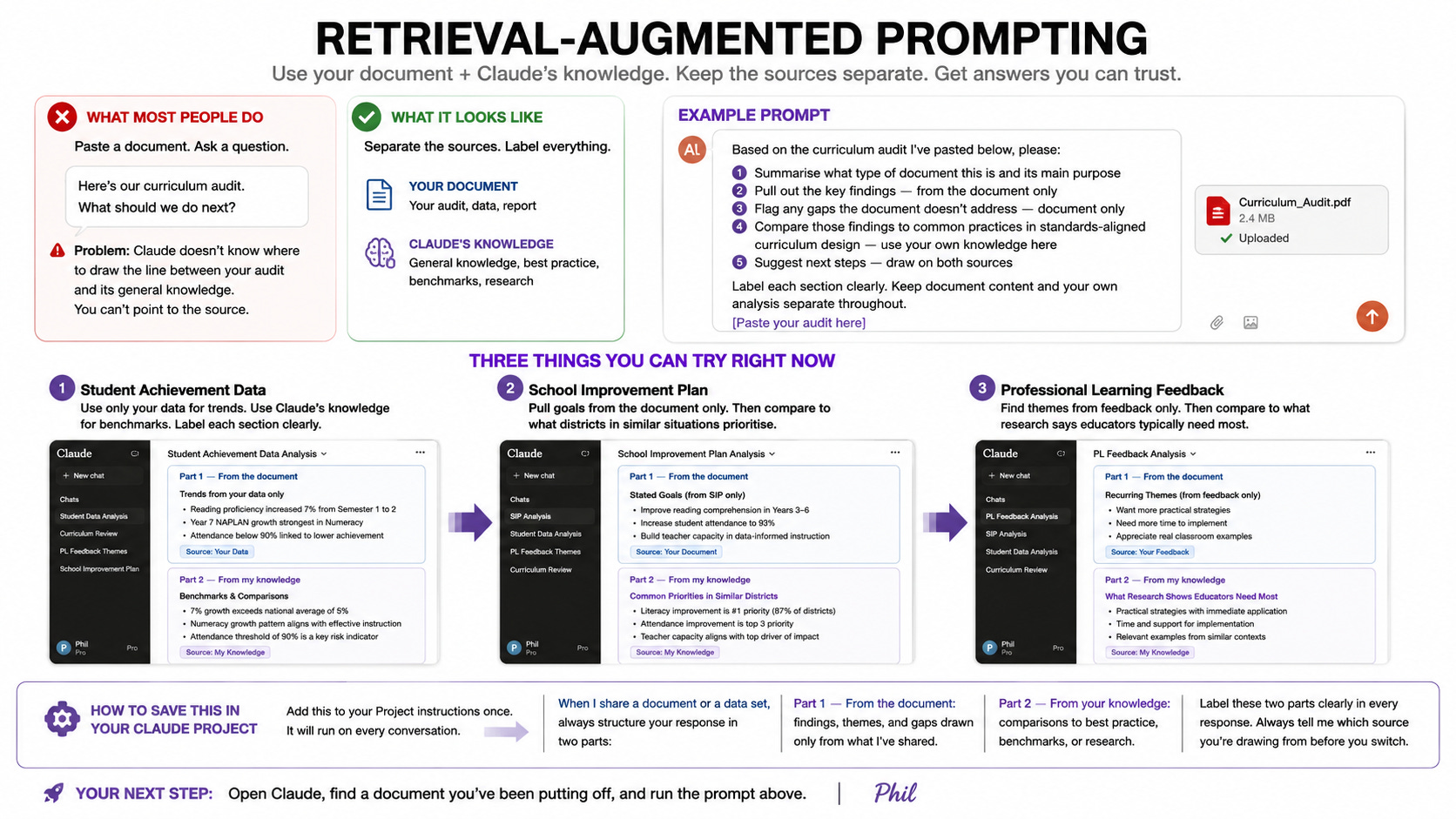
“Retrieval-Augmented Prompting.” Say it out loud and it sounds like something a developer drops into a meeting right before everyone looks at their phones. Here’s what it actually means: you give Claude your specific document, your audit, your student data, your district report, and you tell it which parts to pull from your material and which parts to pull from its own general knowledge. Two sources. Kept separate.
❌ What most people do
Paste a document. Ask a question.
Here's our curriculum audit. What should we do next?The problem is that Claude doesn’t know where to draw the line between your audit and everything it already knows. You don’t know either. You might get back recommendations that sound confident and relevant but have nothing to do with what’s actually in your document. If a curriculum coordinator asks where the advice came from, you can’t point to anything.
✅ What it looks like when you separate the sources
Prompt:
Based on the curriculum audit I've pasted below, please:

1. Summarise what type of document this is and its main purpose
2. Pull out the key findings — from the document only
3. Flag any gaps the document doesn't address — document only
4. Compare those findings to common practices in standards-aligned
   curriculum design — use your own knowledge here
5. Suggest next steps — draw on both sources

Label each section clearly. Keep document content and your own
analysis separate throughout.

[Paste your audit here]
Three things you can try right now
Paste last semester’s student achievement data into Claude. Add this line at the top of your prompt: “Use only this data for trends. Use your general knowledge for benchmarks and comparisons. Label each section clearly.”
Drop in a school improvement plan and ask Claude to pull the stated goals from the document only, then separately tell you which of those goals are most commonly prioritised in districts facing similar challenges.
Take any professional learning session you’ve run. Paste the participant feedback. Ask Claude to identify recurring themes from the feedback only, then compare those themes to what research suggests educators typically need most. I often turn it into slide decks. This is why metacognition is important.
How to save this in your Claude Project
If you regularly work with school data, audit reports, or client documents, add this to your Claude Project instructions. You type it once and it runs on every conversation in that project.
When I share a document or a data set, always structure your
response in two parts:

Part 1 — From the document: findings, themes, and gaps drawn
only from what I've shared.

Part 2 — From your knowledge: comparisons to best practice,
benchmarks, or research.

Label these two parts clearly in every response. Always tell me
which source you're drawing from before you switch.
Open Claude, find a document you’ve been putting off, and run the prompt above.
Phil